


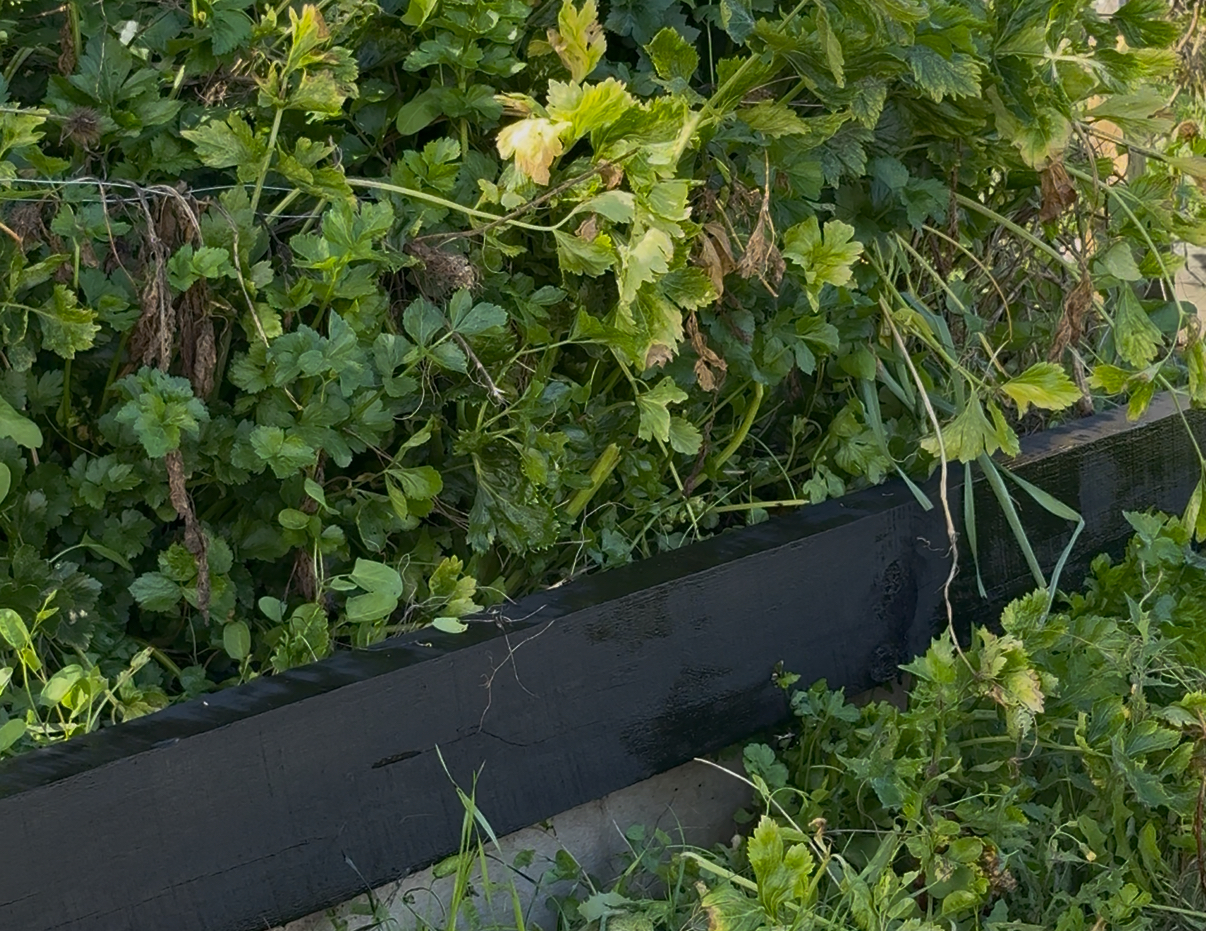
How to Protect Raised Garden Bed Wood Without Synthetic Chemicals: Linseed Oil and Iron Oxide
A simple alternative for painting and protecting the wood of your benches, avoiding conventional preservatives and prioritizing the materials we use near our food.
When I started building my grow beds, one of my biggest concerns was finding a way to protect the wood without using paints, varnishes, or conventional synthetic chemical treatments near the place where I grow my food.
I spent a lot of time looking for alternatives. I wanted to find a painting that was as clean and simple as possible, made with known ingredients, without added solvents or synthetic preservatives.
And, although it seems incredible, finding something that met those characteristics was really difficult.
Most of the products I found were formulated to protect wood against moisture, fungi, and deterioration, but not necessarily with the intention of using them near crops intended for human consumption.
My priority was different.
I didn't need a paint that would guarantee that the wood would last forever. I fully understand that wood is a natural material and that, exposed to moisture, soil and microorganisms, it will eventually degrade.
What really mattered to me was avoiding introducing conventional synthetic treatments into a space where I am growing my own food.
For the same reason, I also decided to use untreated wood without preservatives to build my benches.
I know that that can mean that the wood will last less, especially when it is in constant contact with moisture and the ground. But for me, it is a compromise worth taking.
I prefer to have to replace some boards before using materials whose composition I don't know near my food.
Finding an alternative to protect that wood was almost a research project. I reviewed ingredients, formulations, and different traditional methods until I came up with a very simple mixture: pure linseed oil and iron oxide pigment.
I have been using this preparation in my cultivation beds for about five years now, and so far the results have been very good.
It’s not a miracle solution, nor does it claim to be. The wood continues to age, but the oil helps to reduce the absorption of moisture and the pigment provides a color finish that I love.
In addition, it is a preparation that I can reapply when necessary.
After five years, I still use it and I intend to continue doing so.
Today I want to share my recipe, how I prepare it, what materials I use, and some important considerations if you are also looking for alternatives to conventional protective products for your garden.
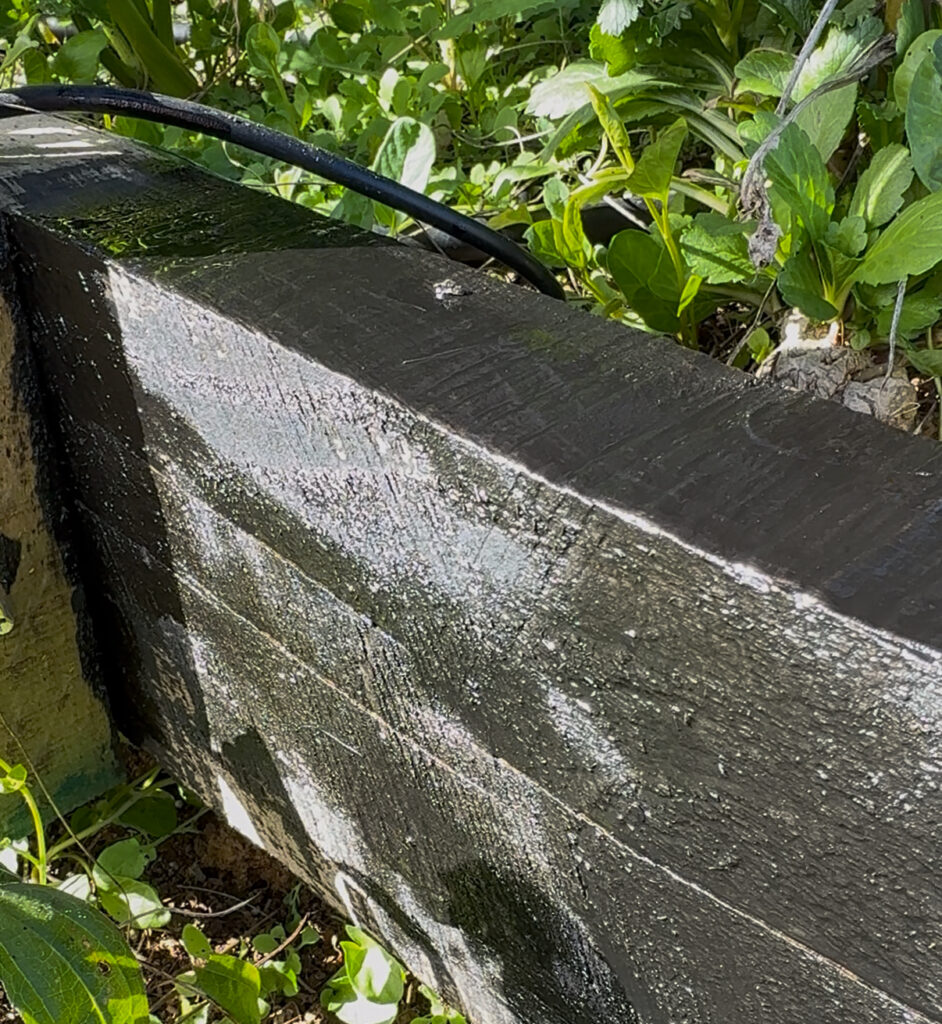
Why do I use linseed oil and iron oxide?
This mixture combines two ingredients that have historically been used in wood finishing.
Pure flaxseed oil
Linseed oil is obtained from the seeds of flax (Linum usitatissimum).
It is a drying oil, which means that when it comes into contact with oxygen, it undergoes a process of oxidation and polymerization that allows it to gradually harden.
When applied to wood, it helps reduce moisture absorption.
However, it is important to understand that it does not completely waterproof the wood or guarantee that it will not rot.
I use pure linseed oil, without metallic solvents, or other additives.
This is important because some products marketed as roasted flaxseed oil contain added substances to accelerate the drying process.
Iron oxide pigment
Iron oxides have been used for centuries as pigments for paints and finishes.
They are responsible for many of the reddish, ochre, yellow, and brown colors we find in both traditional pigments and modern paints.
In this recipe I use iron oxide to give the wood color.
It is important to choose a pigment of known composition, preferably with a technical datasheet, and to verify that it does not contain additives or unwanted contaminants.
The fact that a pigment is of mineral origin does not automatically mean that any commercial presentation is harmless.
My recipe for painting the cultivation beds
The preparation is very simple and only requires two ingredients.
Ingredients
- 2 parts pure flaxseed oil.
- 1 part of iron oxide pigment.
The ratio is 2:1, measured by volume, not by weight.
For example, you can use two measures of linseed oil and one measure of pigment, always using the same container.
This is the ratio I personally use. It is not a standardized formulation or a certified treatment for contact with food.
Materials
You will need a container to prepare the mixture, a stirring utensil, a brush, gloves, and protection to avoid inhaling the pigment powder during preparation.
You will also need clean and dry wood.
See how I prepare the mixture
In this reel I show you how I prepare the mixture that I have been using for about five years to paint my grow beds.
Step-by-step preparation
1. Prepare the ingredients.
It measures two parts of pure flaxseed oil and one part of iron oxide pigment, using the same container as a reference.
2. Add the pigment.
Add the iron oxide gradually to the flaxseed oil.
Do it carefully to avoid creating dust. It is recommended to work in a ventilated place and use appropriate respiratory protection for fine particles.
3. Mix until it is integrated.
Stir until you get a homogeneous preparation, without visible lumps of pigment.
The consistency can vary depending on the type of pigment used.
4. Prepare the wood.
Before applying the mixture, make sure the wood is clean, dry, and free of dust.
If you are renovating an old finish, first remove any loose or damaged parts.
5. Apply a thin layer.
Apply the mixture with a brush, following the direction of the wood fibers.
Avoid leaving oil accumulations on the surface.
This preparation contains a high proportion of pigment, so it is advisable to first test it on a small piece of wood to check its consistency, adhesion and drying time.
6. Let it dry and cure.
Leave the wood in a ventilated and protected place from rain while the finish dries.
Pure flaxseed oil may take quite a while to harden. The time will depend on the temperature, ventilation, thickness of the application and the characteristics of the product.
Remember that being dry to the touch does not necessarily mean that the oil has finished curing.
How long does this painting last?
This is one of the questions I get asked the most.
In my experience, the finish needs maintenance because exposure to the sun, rain, and the conditions of the garden gradually wear it down.
I recommend checking the wood and reapplying the mixture approximately every one or two years, Depending on your state.
It is not necessary to wait for the finish to disappear completely.
Personally, I consider this maintenance to be a reasonable commitment.
My goal was never to make the wood last forever, but to find an alternative to conventional preservatives that would better meet my priorities.
After using it for about five years, I am still satisfied with the results.
That said, my experience does not equate to a durability test nor does it demonstrate that the mixture is harmless under all conditions.
What wood do I recommend for building cultivation beds?
If you are building a shed to produce your own food, one of my main recommendations is to pay attention to the wood you use.
Personalmente, prefiero utilizar madera sin tratamientos químicos preservantes, especialmente cuando estará en contacto directo con la tierra.
Evito las maderas impregnadas de composición desconocida, las traviesas ferroviarias tratadas con creosota y las maderas recuperadas cuyo historial desconozco.
Algunos tratamientos antiguos para madera contienen sustancias como arsénico, cromo o creosota, que pueden representar riesgos de contaminación.
Esto no significa que todos los tratamientos modernos tengan los mismos riesgos, pero prefiero conocer exactamente qué materiales estoy incorporando a mi huerto.
También es importante recordar que aplicar aceite de linaza y óxido de hierro sobre madera previamente tratada no elimina los preservantes que ya contiene.
Por eso, mi elección es comenzar con madera sin tratar.
Sé que puede deteriorarse antes, especialmente en las partes que permanecen enterradas o en contacto constante con tierra húmeda.
Para mí, aceptar una vida útil potencialmente menor es parte de priorizar un huerto donde conozco mejor los materiales que utilizo.
¿Puedo utilizar esta mezcla en colmenas?
Esta es una de las preguntas que más me han hecho desde que compartí mi receta en Instagram.
Investigando sobre el tema descubrí que existen antecedentes del uso de aceite de linaza y pigmentos de óxido de hierro como acabados exteriores para colmenas de madera.
Sin embargo, es importante distinguir entre tratar la estructura exterior y aplicar productos en superficies interiores donde viven las abejas.
Por precaución, limitaría esta mezcla a las superficies exteriores de las colmenas.
No recomendaría aplicarla en el interior, sobre los cuadros ni en las superficies destinadas al contacto con la miel.
El aceite de linaza puro endurece mediante un proceso de oxidación durante el cual pueden liberarse pequeñas cantidades de compuestos volátiles.
Esto no significa que esté demostrado que los vapores de esta mezcla dañen a las abejas, pero sí es una razón adicional para evitar aplicaciones interiores innecesarias.
También es importante dejar que el acabado cure completamente antes de poner la colmena en funcionamiento.
Aunque existen antecedentes de uso de estos ingredientes en apicultura, todavía no he probado personalmente esta receta en mis propias colmenas.
¿Y en las lombricomposteras?
En el caso de las lombricomposteras, sería todavía más cuidadosa.
Las lombrices viven en contacto directo con el material húmedo y el compost, por lo que es importante evitar introducir sustancias cuya seguridad en esas condiciones no esté demostrada.
Si se utiliza esta preparación, consideraría únicamente su aplicación en las superficies exteriores de una estructura de madera.
No recomiendo aplicarla en las paredes interiores que estarán en contacto permanente con las lombrices o el vermicompost.
Tampoco he probado personalmente esta mezcla en lombricomposteras, por lo que prefiero no atribuirle propiedades que todavía no he podido comprobar.
Precauciones importantes al utilizar aceite de linaza
Aunque esta receta utiliza ingredientes sencillos, hay algunas precauciones que no debemos pasar por alto.
El aceite de linaza puede provocar combustión espontánea en los trapos
Los trapos, papeles y otros materiales absorbentes impregnados con aceite de linaza pueden calentarse durante el proceso de oxidación.
Si se dejan amontonados, el calor puede acumularse y provocar un incendio.
Por eso, nunca debes dejar trapos impregnados con aceite de linaza formando una pila.
Para gestionarlos de manera segura, puedes mantenerlos completamente sumergidos en agua dentro de un recipiente metálico cerrado mientras gestionas su eliminación conforme a las indicaciones locales.
Otra posibilidad es extenderlos individualmente al aire libre, sobre una superficie no combustible y en un lugar seguro, hasta que estén completamente endurecidos.
Evita inhalar el pigmento
Durante la preparación, manipula el óxido de hierro con cuidado para evitar levantar polvo.
Utiliza protección respiratoria adecuada y trabaja en un espacio ventilado.
No confundas ingredientes naturales con seguridad garantizada
El hecho de que una preparación no contenga disolventes sintéticos añadidos no significa automáticamente que sea inocua para cualquier organismo o aplicación.
La composición, la pureza de los ingredientes y las condiciones de uso son importantes.
Mi experiencia positiva durante cinco años es una observación personal, no una certificación de seguridad para cultivos alimentarios.
¿Vale la pena utilizar esta mezcla?
Para mí, definitivamente ha valido la pena.
Después de aproximadamente cinco años utilizando aceite de linaza y óxido de hierro en mis camas de cultivo, sigo eligiendo esta preparación.
Me gusta su sencillez, el acabado que aporta a la madera y la posibilidad de renovar el tratamiento cuando comienza a desgastarse.
Pero, sobre todo, me gusta poder tomar decisiones más conscientes sobre los materiales que utilizo en mi huerto.
No busco que mis bancales duren para siempre.
Busco cultivar mis alimentos en un entorno donde pueda reducir, en la medida de lo posible, el uso de tratamientos sintéticos convencionales y conocer mejor los materiales que incorporo.
Para mí, ese es un compromiso que vale la pena.
Y si estás buscando alternativas para proteger la madera de tus propias camas de cultivo, espero que compartir mi experiencia te ayude a investigar y encontrar la opción que mejor se adapte a tu huerto.
Materiales que utilizo
- Oxido de hierro
- Aceite de Linaza puro.
MATERIALES EN MERCADOLIBRE CHILE
Puedes incluir aceite de linaza puro, pigmento de óxido de hierro, brochas y otros materiales necesarios.
Aviso de afiliación: Algunos enlaces de este artículo son enlaces de afiliada, puedo recibir una comisión sin costo adicional para ti.
